Geometric Optics
Welcome, to chapter 4 of PC5131 on Geometric Optics. This is basically the behaviour of light when passing through lenses, mirrors and the like. Remember your ray diagrams from Y1.
Lenses
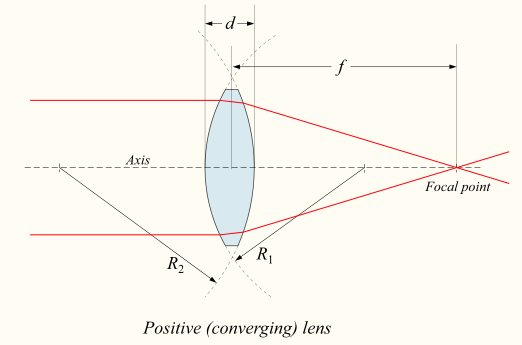
Assuming negative otherwise... \(f\): positive if converges light rays \(s\): positive if same side as input ray \(R_1\): positive if same side as input ray \(s'\): positive if same side as output ray \(R_2\): positive if same side as output ray \(n\): \(n_{glass}\)
Convex/Concave Mirrors
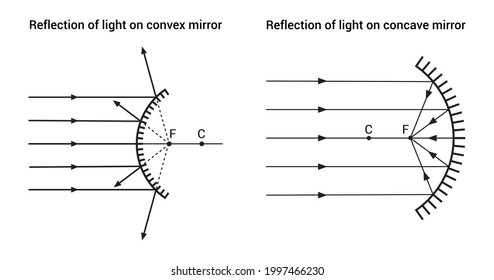 \(\frac 1f = \frac 1s + \frac 1{s'}\)
\(|f| = \frac 12 R\)
Assuming negative otherwise...
\(f\): positive if converges light rays (i.e. concave)
\(s\): positive if same side as input ray
\(s'\): positive if same side as output ray
\(R\): always positive, radius of mirror
\(\frac 1f = \frac 1s + \frac 1{s'}\)
\(|f| = \frac 12 R\)
Assuming negative otherwise...
\(f\): positive if converges light rays (i.e. concave)
\(s\): positive if same side as input ray
\(s'\): positive if same side as output ray
\(R\): always positive, radius of mirror
Refraction on Spherical Surface
 \(\frac{n_1}u + \frac{n_2}v = \frac {n_2 - n_1}{R}\)
Just memorise, but if you must know...
\(\frac{n_1}u + \frac{n_2}v = \frac {n_2 - n_1}{R}\)
Just memorise, but if you must know...
Derivation
Snell's law: \(n_1\sin i = n_2\sin r\) \(i = \angle NOM + \angle NCM; r = \angle NCM - \angle NIC\) For some reason NM is small, so we can apply small angle approximation $$ \begin{aligned} &n_1 i = n_2 r\ \implies &n_1 (\angle NOM + \angle NCM) = n_2 (\angle NCM - \angle NIC) \end{aligned} $$
\(n_1(\frac 1u + \frac 1R) = n_2(\frac 1v - \frac 1R)\)