Global Efforts
Worldwide Impact
Underdeveloped Countries
Behind on global environmental efforts although they often they face the brunt of the damage caused by climate change, especially island nations, and those near the tropics.
- Carribean: Anomalous 30 Tropical storms in 2020; Pacific Islands: 3 Cyclones in 2020-2021. Uganda: Landslides (causing soil erosion, burying settlements, farms) and flooding more frequent.
- Internation institute for Environment and Development (IIED) showed 46 of the world's least developed countries don't have finanical means to "climate proof" themselves. They need at least $40bn a year, but between 2014-18, just $5.9bn was delivered.
- Why are they behind in fighting climate change?:
- Immediate need to put food on table
- Weak policy design, implementation and enforcement.
- Not enough foreign financial aid.
Malicious
-
Big Oil: Investigative reports by multiple activist organizations revealed Big Oil companies such as Exxon Mobil perpetuated falsehoods in climate science, and were long aware of the extent to which they were harming the environment since 1957.
-
Report stoked public outrage resulting in protests and through #ExxonKnew
-
https://www.nytimes.com/2016/05/24/science/public-campaign-against-exxon-has-roots-in-a-2012-meeting.html?_r=2
-
-
Madagascar Logging:
- Jamaica Bauxite:
Not very good ones
Carbon Offsets
- Summary: Criticised for being a smokescreen that enables polluters, and doesn't help much with achieving net zero. 2 Types of offsets: Avoided emissions and Negative emissions.
-
Examples:
- US Airline Jetblue funds solar/wind farms, forest protection, and landfill gas capture, because it can't just stop burning jet fuel
-
Evaluating Offsets:
- Additionality: Was anyone going to cut the tree in the first place?
- Permanance: Is the forest going to be preserved forever
- Double-Counting: Landowner makes protection promizes to multiple companies
- Leakage: If I can't cut this forest, cut that one instead
Good ones
COP26 & The Glasgow Climate Pact
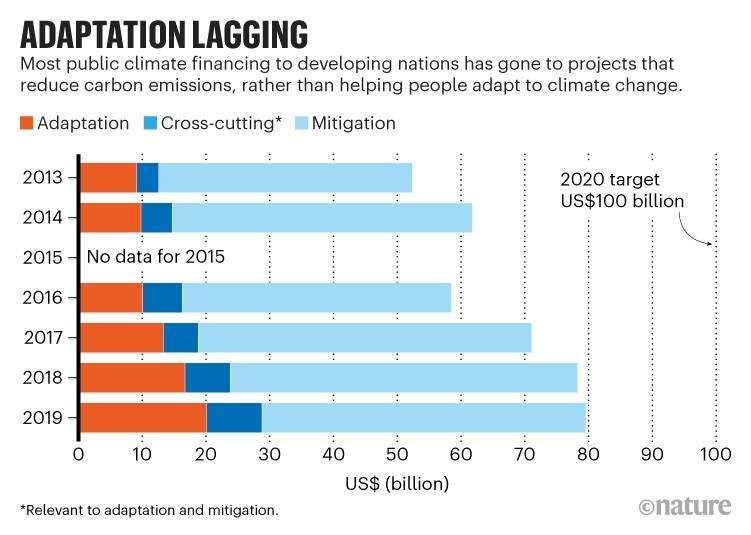
- Under UN climate convention, EU & 23 developed countries pledged $100bn a year to fund climate projects in developed nations. But Organization for Economic Cooperation and Development (OECD) said although $80bn was made available in 2018, only 21% was used for adaption projects in 2019 while less than half went to mitigation. The Paris agreement tried to balance mitigation and adaptation projects as while mitigation reduces GHG emissions, adaptation funds are needed to climate-proof developing nations.
- The broken $100-billion promise of climate finance — and how to fix it
Innovations
- Ocean shipping produces 2% of global emissions but hard to reduce while maintaining productivity. But startup FleetZero propose making use of large batteries to electrify ships, given how electric vehicles have broken into the mainstream consumer market.
Activism
-
What critical mass is required to compel governments to take its demands more seriously?
-
Erica Chenoweth's research found that nonviolent movements require the active participation of at least 3.5 percent of a population in order to achieve serious political change.
-
This so-called 3.5 percent rule was derived from Chenoweth’s study of hundreds of protests from 1900 to 2006, and has made an impact on contemporary movements, including Extinction Rebellion, an international climate-advocacy group based in London whose founders cite Chenoweth as a source of inspiration (the group publicly states that it needs the involvement of 2 million people, or roughly 3.5 percent of the British population, in order to succeed).
-
The following are her opinions paraphrased
-
Nonviolent protests are more successful than their violent counterparts because they are better at eliciting broad and diverse support from the societies in which they take place. This makes these movements more inclusive, and also more innovative.
-
These kinds of protests don’t necessarily succeed because they appeal to the morality of those in power, but rather because they effectively constrain a government’s options by undermining its support in various pillars of society, such as bureaucrats, the media, and business elites. If 3.5 percent of a country’s—or the world’s—population backs any one issue or policy proposal, that is a substantial enough voting bloc, consumer market, and workforce to get those in power to pay attention.
-
But with few exceptions, none of these efforts has been able to surpass the 3.5 percent threshold. Part of the challenge comes down to the fact that many of these movements were stymied by the pandemic, which forced them online. See the criticism section
Examples
- Fridays for Future, which was started by Thunberg in 2018 as a solitary school strike in protest of climate inaction, has since attracted millions of participants around the world and earned Thunberg an international platform, as well as high-profile meetings with world leaders and global institutions.
- In Britain, Extinction Rebellion has been credited with influencing Parliament’s 2019 decision to declare a climate emergency and commit to reaching net-zero carbon emissions by 2050, making the country the first major economy to do so.
- In the United States, the youth-led Sunrise Movement has been widely recognized for its role in elevating the climate crisis on the national agenda.
Criticism
- xtinction Rebellion, as well as its U.K.-focused offshoot, Insulate Britain, has become notorious for its commitment to civil disobedience, which has at times involved blocking bridges, freeways, and public transport. A recent poll found that less than 20 percent of Britons have a positive view of Extinction Rebellion.
- Insulate Britain, which has been on the receiving end of negative press over its recent spate of road blockages, has also seen a decline in public support.